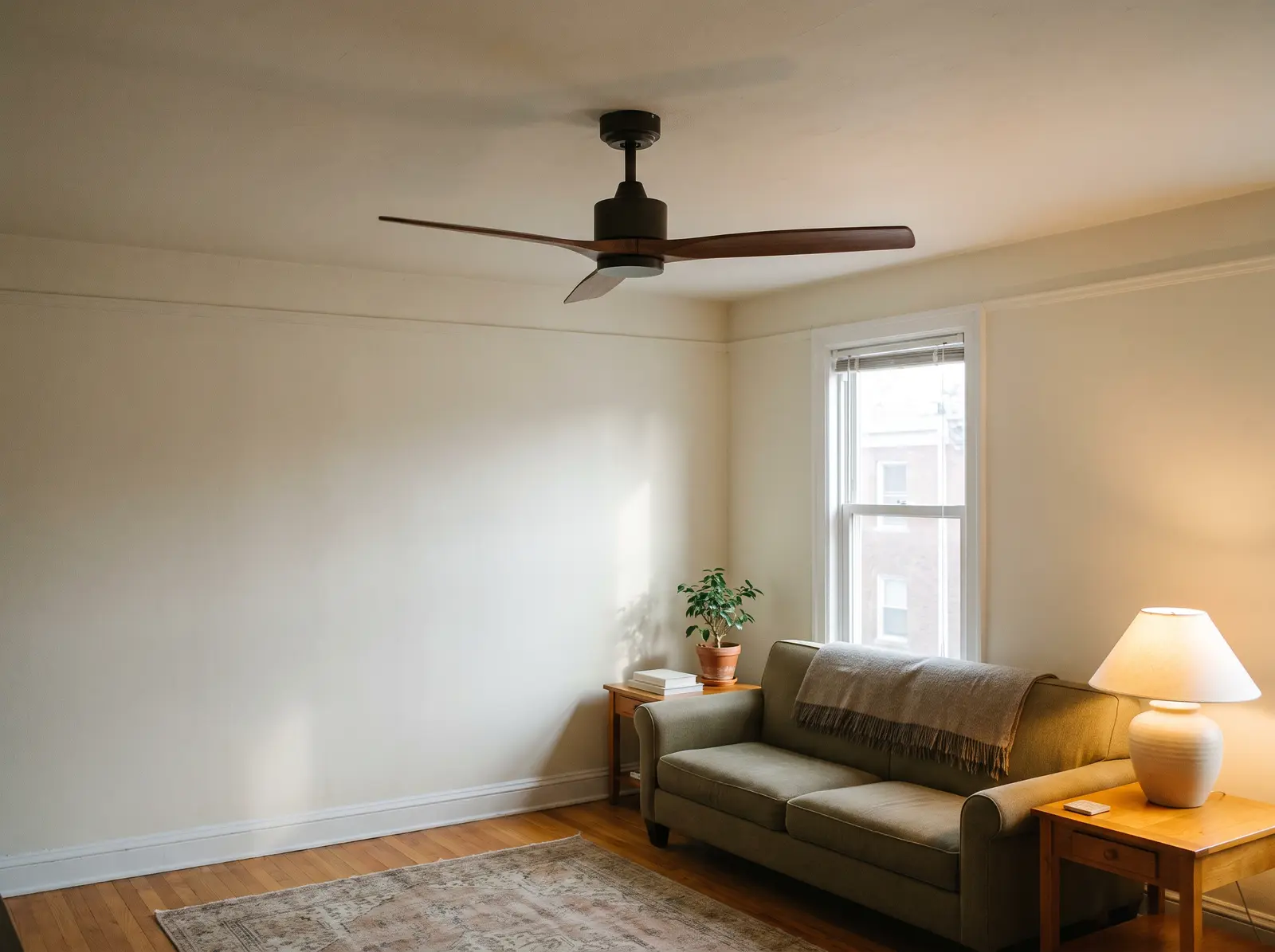

The easiest test is how the air feels when you stand under the fan. We’ll show you how to check the direction, how to switch it and when it helps. You can find more room-by-room ideas in our energy at home guides.
Which way should a ceiling fan turn in summer?
In summer, set it to spin counterclockwise when you look up, so the air blows down on you.[1,2] The breeze helps you feel cooler, but it doesn’t make the room’s air any cooler.[1]
Direction, looking up
Speed
- Summer
- Whatever feels like a nice breeze
- Winter
- Low[1]
Air under the fan
What it does
Stand under the fan and check that you feel a breeze.[1] Switches look different on every fan, so trust the air more than the switch.[2]
Which way should a ceiling fan turn in winter?
In winter, set it to spin clockwise on low when you look up.[1,2] That pulls air up under the fan, which brings the warm air near the ceiling back down into the room.[4] The fan doesn’t make heat. It moves the warmth you already have.[4]
Keep it on low, because a faster speed can make a chilly breeze.[2] If it feels drafty, or no warmer, turn it down or off. And if the room doesn’t need heat, you can skip winter mode.
How can you tell which way your fan is spinning?
Stand under the fan and look up.[2] Watch one blade as it passes the top of the circle. Low speed makes it easier to see.
- If it moves to your left, the fan is spinning counterclockwise.
- If it moves to your right, it’s spinning clockwise.
Then check the air. In summer you should feel a breeze on you.[2] In winter you want a gentle flow, without a chilly draft.[1,2]
How do you change a ceiling fan’s direction?
Your fan may have a small switch on its body, a remote or an app.[2] The steps are different for each, so follow your fan’s manual.[2,5]
Step by step
Switch the direction and check it
Find the control in the manual
Look up how your model reverses: a switch, a remote or an app. Don’t assume the light or speed button does it.[2]
For a switch, turn the fan off first
Turn the fan off and wait until the blades stop completely before you reach for the switch.[2] If you can’t reach it safely, leave it and ask building maintenance for help.
For a remote or app, follow the manual
Some remotes need the fan running to reverse it, like the one for Hunter’s Crescent Falls fan.[5] Even then, never touch the blades or reach for a switch while they’re moving.
What if your ceiling fan has no reverse switch?
Check the manual before you decide something’s wrong. Some fans reverse with a remote or an app instead of a switch.[2] Use the steps for your own model, not another fan’s.[2,5] If the manual doesn’t mention a reverse setting, your fan may not have one.
If the fan’s light flickers, that’s a different problem. See our guide to what to check when lights flicker.
Does reversing a ceiling fan really save energy?
Not always. ENERGY STAR pairs using a fan with changing your thermostat.[1] In summer, the breeze may let you set the AC warmer and still feel comfortable.
The fan uses electricity too, so running it with the AC set the same isn’t a saving. In winter, it moves warm air you already have, and it doesn’t make heat.[1,4] If your heat is included in your rent, a warmer room may not change your electric bill.
How much electricity a fan uses depends on the model. Its EnergyGuide label helps you compare, and your cost depends on how much you run it and your local price.[6] Find the label on the maker’s website, then estimate your ceiling fan’s running cost. For the bigger picture, see what uses the most electricity at home.
Should you leave a ceiling fan on all day?
No. Turn the fan off when nobody’s in the room, in summer and winter.[1,4] The breeze cools people, not the room, so there’s no need to switch it on before you get home.[1]
When you’re home, run it when it makes you more comfortable. On a mild day, you might want it one afternoon and not the next.
How Public Grid helps
Once your fan feels right, we can help with your bills too. When you connect your electricity account, we look for ways to save while you keep paying your utility as usual.[7] It’s free to sign up, with no contracts.
Common questions
Sources · 7
- 1Ceiling Fan Installation and Usage Tips · ENERGY STAR
- 2Ceiling Fan Direction Guide · Hunter Fan
- 3Design Guide, section 2.4.2.3: Small Space Research Study · Big Ass Fans
- 45 Tips to Help You Save on Energy Bills this Winter · US Department of Energy
- 5Crescent Falls model 50736 manual, printed page 9 · Hunter Fan
Show all 7Show fewer
- 6How To Use the EnergyGuide Label To Shop for Home Appliances · Federal Trade Commission
- 7Home page and common questions · Public Grid
