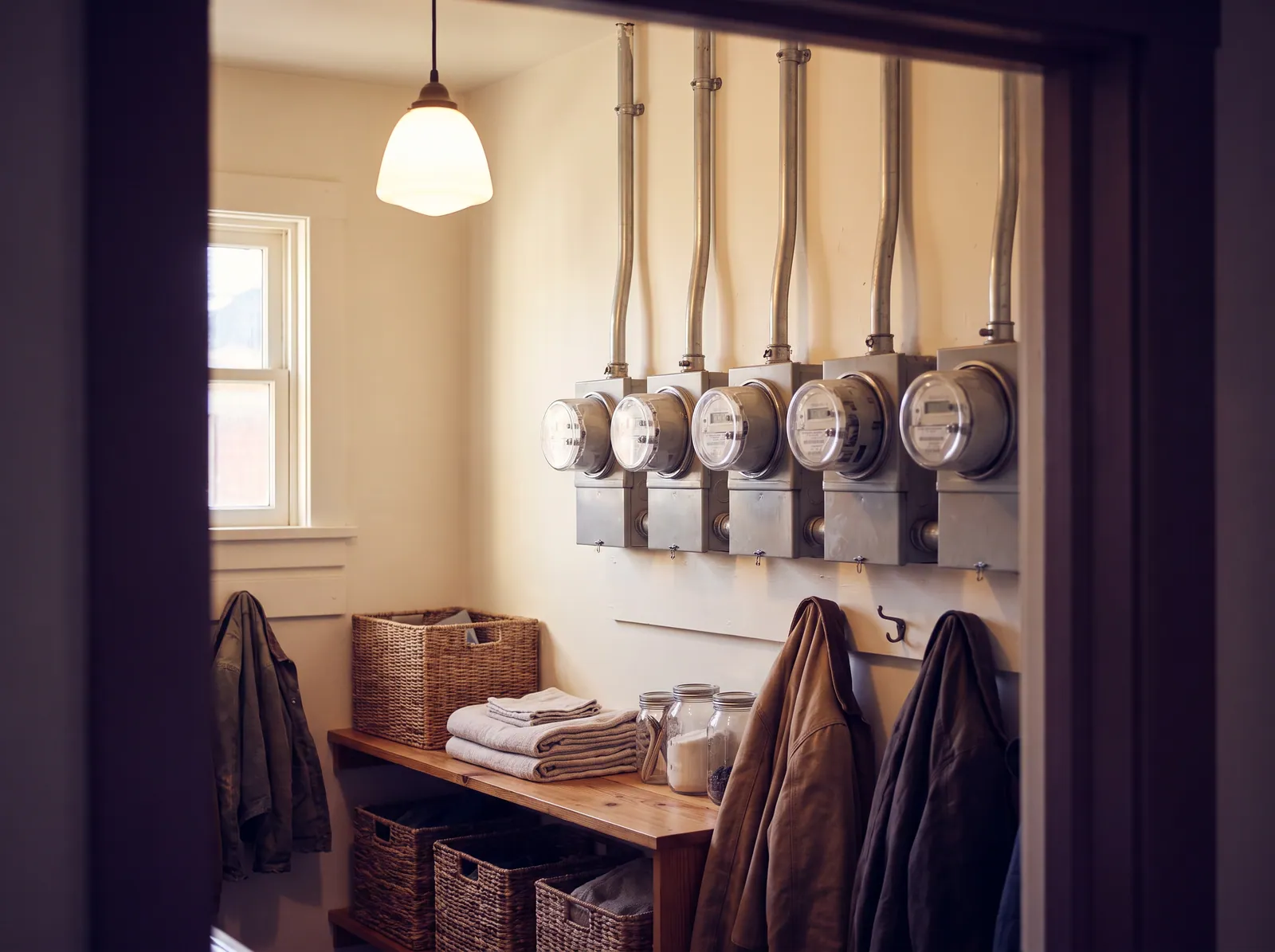

About 9 in 10 US homes paid all their own energy bills in a 2020 federal survey.[1] In apartments, it depends on how the building is metered. Here’s how each setup works and how to tell which one you have. For more basics, browse our guides on how energy works.
What are the three ways an apartment can be metered?
Direct metered (individually metered)
Your unit has its own utility meter, and the utility bills you for what it records. The account is in your name, and you pay the utility yourself.
Master metered
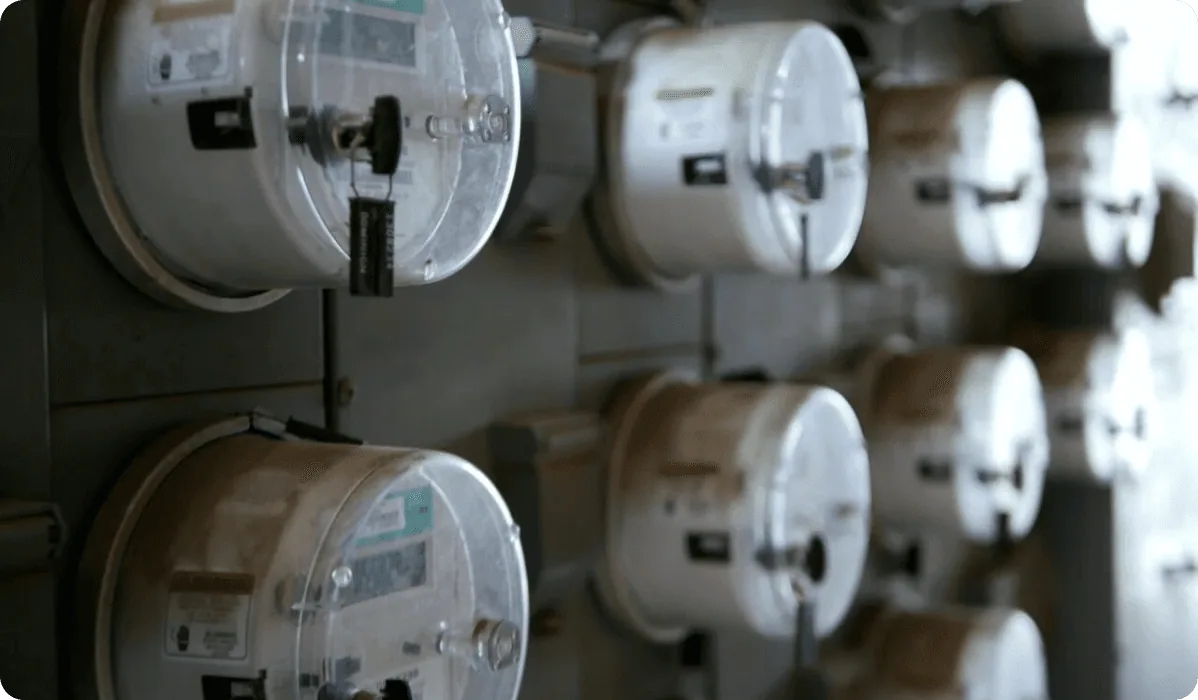
One utility meter measures the whole building, so the owner gets one bill from the utility. The cost then reaches residents in one of two ways.
- It’s included in your rent. You don’t get a separate electric bill.
- It’s billed back to each unit. The property bills you for your share, based on a submeter on your unit or on a formula called RUBS.
Submetered
The building still has one master meter, and the owner adds a smaller meter, called a submeter, to each unit. You pay for what your submeter records, on a bill from the property or a billing company. So every submetered building is master-metered, but not every master-metered building is submetered.
What’s the difference between RUBS and submetering?
A submeter measures your unit’s use, and RUBS doesn’t. A submeter counts your kilowatt-hours (kWh), the unit electricity use is measured in, and your charge follows that count.
RUBS, short for ratio utility billing system, splits the building’s bill instead. The split is often based on your unit’s size or how many people live there. Both come as a charge from the property, so they’re easy to mix up.
What it’s based on
- Submetered
- Your unit’s own meter
- RUBS
- Often your unit’s size or how many people live there
What the bill shows
- Submetered
- A meter reading or the kWh you used
- RUBS
- The building’s total and your share
A typical line
- Submetered
- Your usage: 512 kWh
- RUBS
- Your share: 4.2%
Does using less lower it?
- Submetered
- Yes, directly
- RUBS
- Only as part of the building’s total
Direct, master or submetered: what’s the difference?
The biggest difference is who the utility’s customer is. When it’s you, the account, the bill and your usage are in your name. When it’s the property owner, they belong to the building’s account instead.
Direct metered
- Who the utility bills
- You
- Who sends you a bill
- The utility
- What your charge is based on
- Your own meter
Submetered
- Who the utility bills
- The property owner
- Who sends you a bill
- The property or a billing company
- What your charge is based on
- Your unit’s submeter
RUBS
- Who the utility bills
- The property owner
- Who sends you a bill
- The property or a billing company
- What your charge is based on
- A share of the building’s bill
Included in rent
- Who the utility bills
- The property owner
- Who sends you a bill
- No separate bill
- What your charge is based on
- Part of your rent
Supplier choice and community solar work through a utility account. Where it’s offered, anyone with a utility account can choose the company that supplies their power.[3] In New Jersey, community solar works the same way, with one subscriber for each electric meter.[4] When the property holds the account, those choices are up to the account holder.
How do I know which setup my apartment has?
Your bill is the quickest clue, and your lease usually spells it out too. Look at who sends the bill and whether it shows your unit’s meter reading.
Find your answer
What kind of electric bill do you get?
- “A bill from the utility, in my name.”
You’re direct-metered.
Your unit has its own utility meter, and you’re the utility’s customer. You can see your usage in your utility account, join programs like community solar where they’re offered, and connect your account to Public Grid.
- “A bill from the property that shows my kWh or reading.”
You’re submetered.
A submeter on your unit measures what you use. You pay for that on a bill from the property or its billing company, so using less lowers your charge.
- “A bill from the property for a share of the building.”
You’re on RUBS (ratio utility billing).
Your charge is a share of the building’s bill, usually based on your unit’s size or how many people live there. Your lease or the billing company can tell you which one your building uses.
- “No bill. Electricity is included in my rent.”
You’re master-metered, with utilities included.
The owner pays the building’s electric bill, and the cost is part of your rent. You won’t get an electric bill, and there’s no utility account in your name.
- “I’m not sure, or I haven’t moved in yet.”
Check the lease and the meters.
The utilities section of your lease usually says who pays for electricity. You can also look for a meter labeled with your unit number.[2] If you set up electricity yourself, you’re direct-metered, and our guide to setting up electricity in a new apartment walks you through it.
How does each setup show up on your bill?
If you’re direct-metered, you get a bill from the utility with your name, your account number and your meter’s kWh. Your usage drives both the supply charge (the electricity itself) and the delivery charge.
- Your kWh at the supply rate
- Your kWh at the delivery rate
If you’re submetered or on RUBS, the charge comes from the property or its billing company instead. The table above shows what each one looks like. If electricity is included in your rent, you won’t see a separate charge at all.
Does a smart meter change how you’re billed?
No. A smart meter is the utility’s own meter, not a way of billing. In 2022, about 72% of US electric meters were smart meters. They record your use at least every hour and share it with you at least once a day.[5]
- Direct-metered: you can usually see hourly or daily use in your utility account, and many utilities let you download it with a “Green Button.”[6]
- Submetered: your usage comes from the property’s billing company, on your bill or its website.
- RUBS or included in rent: there’s no reading for your unit, because only the building is metered.
How Public Grid helps
If your unit is direct-metered, you can connect your utility account, and we’ll look for programs and rates that can lower your bill. If you’re moving somewhere you pay the utility, we can set up service at move-in. In a master-metered building, the account belongs to the property, so there’s nothing for you to connect.
Common questions
No. A submeter is a meter the property adds to your unit, behind the building’s master meter, and the property or its billing company reads it. A smart meter is the utility’s own meter, and it records your use at least every hour.
No. The owner pays the building’s electric bill, and the cost is part of your rent. When you compare apartments, compare that rent with the rent plus a typical electric bill at a place where you pay your own. Our guide to utilities included explains what to check for each service.
Public Grid connects to a utility account in your name, so it works when your unit is direct-metered. If you’re submetered or on RUBS, the utility account belongs to the property. If you later move to a home where you pay the utility yourself, we can set up service for you at move-in.
The property owner, or a billing company they work with, reads it, often remotely, and bills you from that reading. The utility reads only the building’s master meter.
Sources · 6
- 12020 Residential Energy Consumption Survey, Table CE2.1: Annual household site fuel consumption (payment method for energy bills) · U.S. Energy Information Administration
- 2Locating Your Meter · FirstEnergy
- 3Can customers choose their electricity supplier? · U.S. Energy Information Administration
- 4Community Solar FAQs: Subscribers (New Jersey) · JCP&L (FirstEnergy)
- 5How many smart meters are installed in the United States, and who has them? · U.S. Energy Information Administration
Show all 6Show fewer
- 6Green Button · U.S. Department of Energy
